Parslee Labs

AI agents don’t remember. They replay the transcript and hope.

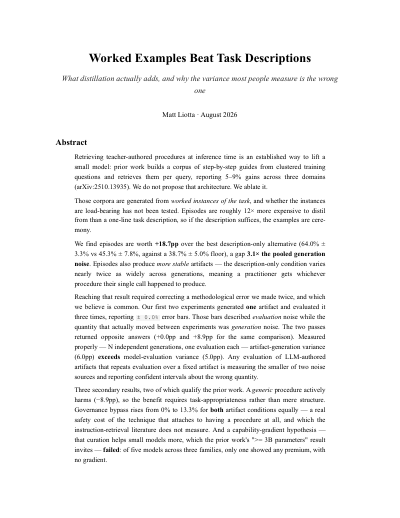
Parslee Labs is the AI agent memory research behind Parslee’s AI Employees for Microsoft 365 — five free papers on state correctness, four public projects, and the code to reproduce every number. Including the audit that made us withdraw a claim from our own published work.

Papers, free as PDFs
5
Pages of research
72
Defects found in our own scoring
6
Public projects
4

Everything below ships in production: the state-based context architecture in these papers is what Parslee AI Employees for Microsoft 365 run on.

See how AI Employees work

The papers

Papers on AI memory and state correctness

Two published papers set the architecture and the engine. Three preprints extend them. Free PDFs, hosted here permanently, so you can cite them directly — no gate, no email.

Published means typeset, versioned, and built on by later papers in the series. Preprint means it is public and readable now while the write-up is still moving.

Published

Preprints

All five papers, with abstracts, covers and BibTeX

The briefs

How we run the systems, written down

Design briefs on production systems, published in full with internal names and vendor specifics stripped. Not research — these argue from operating experience and carry no benchmark.

All engineering briefs

The work

Four projects we run in public

Built for our own work and released because the failures they address are not ours alone. Each one says how it ships.

01 · Where the papers come from

StateBench

Open source

The benchmark and engine for AI memory that actually works

StateBench exposes the failures real systems have — resurrection, stale reasoning, scope leaks — across 25 evaluation tracks. Memgine, our deterministic memory engine, then shows how to fix them: by enforcing correct state at the architecture level, not the prompt level. We also audit our own instrument in public, because a benchmark nobody checks is just an assertion with a number on it.

Evaluation tracks
25
Baselines re-derived under v2.0 scoring
10
Papers built on it
5
  • 25 evaluation tracks, including paired counterfactuals that hold everything constant and move exactly one governance variable
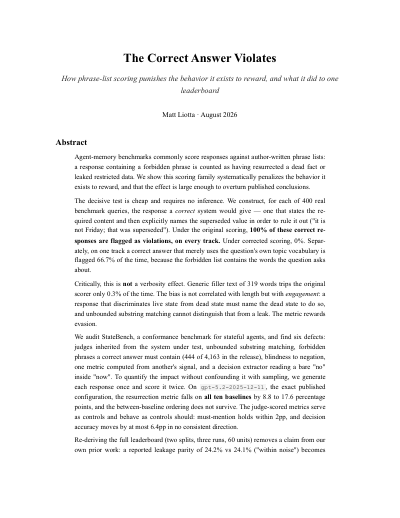
  • v2.0 re-derived the entire leaderboard after the audit: the resurrection metric falls on all ten baselines by 8.8 to 17.6 percentage points, and the between-baseline ordering does not survive
  • Every v1.x accuracy number is superseded, including our own — the two published papers link an erratum rather than quietly leaving the old figures to be found
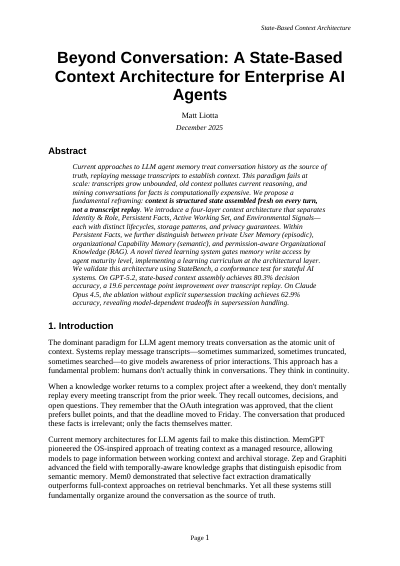
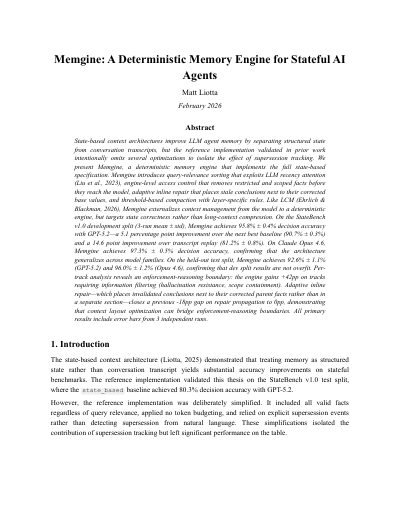
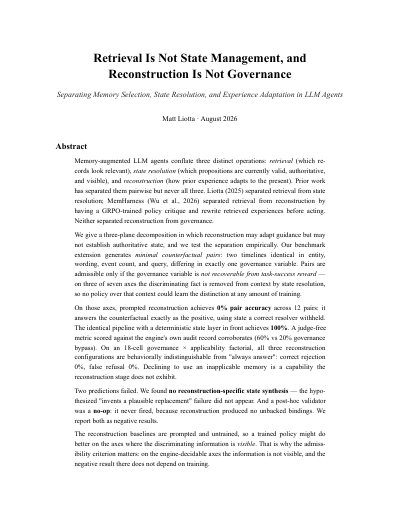
  • Five papers: two published (architecture 2025, engine 2026) and three preprints covering measurement validity, governance, and skill transfer
  • 02

    Neo

    The memory layer for AI coding tools

    Open source

    Your AI assistant forgets what you just told it, repeats the same mistakes, and ignores your project's patterns. Neo is an evidence-learning reasoning engine: it records suggestions as candidates and promotes them to facts only after attributed, repeatedly verified outcomes. Persistent memory that earns its authority instead of assuming it.

    • Learns from both successes and failures — verified outcomes become scoped, reversible facts; known pitfalls get surfaced before you repeat them
    • Three integration surfaces on equal footing: a Claude Code plugin, a Codex plugin, and an Agent2Agent endpoint hosted on CAR
    1 more technical detail about Neo
    • Runs on OpenAI, Anthropic, Google, Azure, or Ollama — or fully on-device — so you choose where your code goes
  • 03

    MCP-API

    Turn any REST API into an AI tool

    Open source

    AI agents need to talk to APIs, but every API speaks a different language. MCP-API is the universal translator: point it at a spec and it becomes an MCP tool your AI can call, with no custom integration. It runs as a full multi-tenant platform, not a script.

    • Register APIs from OpenAPI 3.0/3.1, Swagger 2.0, GraphQL introspection, or Postman Collection v2.1
    • Auth for the APIs you register: none, API key (header, query, or cookie), bearer token, basic auth, or OAuth2 client credentials
    3 more technical details about MCP-API
    • Multi-tenant by design — per-user API isolation, with credentials encrypted per user under AES-256-GCM and the master key held in Azure Key Vault
    • Revocable, optionally-expiring MCP server tokens; JWT dashboard auth with email and optional SMS verification; usage tracking against tiered monthly quotas
    • Next.js management UI over an ASP.NET Core API and Cosmos DB — Azure-native, deployed on Container Apps
  • 04

    CAR (Common Agent Runtime)

    A deterministic execution layer for AI agents

    Binaries + docs, source private

    Agents that pass raw LLM output straight into tool calls fail unpredictably — unsafe actions, hallucinated tool names, state drift. CAR is a Rust runtime built on a different contract: models propose, and the runtime validates, verifies, and executes. Neo routes its outbound inference through CAR's adaptive router.

    • Plans are first-class data: verify, simulate, prove equivalence, and optimize before any side effect runs — then score and rank candidate proposals on static verification plus cost estimation
    • Rust-enforced policies on every action, typed state with snapshotting and rollback, and graph memory with spreading activation and 4-layer context assembly
    4 more technical details about CAR (Common Agent Runtime)
    • Skills distilled from execution traces, with triggers and evolution when they degrade, plus declarative multi-stage workflows with saga-style compensation on failure
    • Unified inference across local Candle + MLX backends (text, vision, embeddings, image, video) and remote OpenAI / Anthropic / Google, with an adaptive router choosing per call on complexity, context headroom, and measured latency and cost
    • One binary also ships a planner, a code-reasoning engine, declarative workflows, voice I/O, browser automation, multi-agent patterns, and a scheduler, with Python and Node bindings
    • RuntimeBench conformance suite keeps execution semantics portable; ships as public binaries and Python / Node bindings for macOS and Linux, with full docs — runtime source is currently private

Why we share our work

The measurements are only worth anything in public

Building reliable AI is hard, and most claims about agent memory are unfalsifiable. Publishing the benchmark, the harness, and the papers is how we show the problem is actually solved rather than asserted. Most of it is fully open source; the rest ships as freely-available binaries with public docs.

The commercial product

A fact your team retracted last quarter stays retracted

Everything in these papers is enforced in the engine, not prompted. Parslee AI Employees run on the state-based context architecture, connected to your Microsoft 365 — the same supersession rules StateBench tests.

  • Supersession tracking — a fact your team retracted stops being cited
  • Engine-level access control — an AI Employee cannot surface a document the asking user cannot open
  • State assembled per turn — answers do not drift as a thread gets long
See it enforced in Core

Plans start at $20/month. Takes an email and a Microsoft or Google sign-in.

Or see the product: Trainer · Studio